



Godan Gilead Sher Visits the Chicago Dojo
On Tuesday, August 27th, members of the Chicago and Southwest Chicago dojos were treated to a special practice. Gilead Sher, godan and former president of Israel Shotokan, was in town on business, and graciously led a practice for the group. Nine members of the Chicago and Southwest Chicago dojos gathered that evening to welcome Gilead, and to soak up every last bit of knowledge he was able to bestow in that short amount of time.
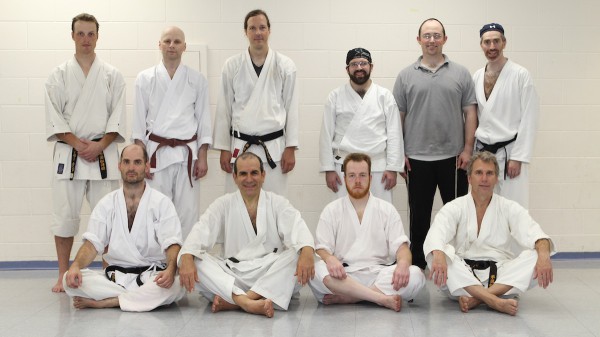
Godan Gilead Sher with the Chicago Dojo. (Photo: Mitch Rose)
It wasn’t long before the theme of the practice started to appear: Timing. Gilead led us through several exercises that, when practiced diligently, can improve one’s timing.
For one of these exercises, the defender was tasked with making an age-uke against a jodan-level oizuki, without moving their feet. Instead of stepping back, stepping in, or stepping to the side, the defender had to hold his ground, and time the block just right so that it would be effective against the full-speed jodan oizuki. Gilead stressed that not getting hit wasn’t good enough. Even if you didn’t get punched, if the opponent ended up very close to you (or on top of you), then you were too late. Instead, the block had to be timed to catch the oncoming oizuki early enough so that, along with a strong feeling and solid hips, the opponent would lose their balance and be driven back with the age-uke.
Watching Gilead demonstrate the above technique was impressive. He was able to completely drive back the attacker using his age-uke, rendering that attack and any other attack (as the attacker was forced to move backwards) ineffective. He defeated his opponent without throwing a single punch or kick. Gilead spoke to this point, stating that with good timing, you can severely disrupt your opponent’s attack, potentially breaking their will to attack your further, and thus end the engagement. I have heard that godans should be capable of ending a confrontation without fighting. Perhaps this is an example of that.
Continuing with the focus on timing, we went on to practice kawashi. Kawashi, Gilead described, is a penetrating movement and feeling similar to irimi. As soon as your opponent decides to attack, you go in—straight in—with a strong feeling, and “pass through” your opponent. The difference between kawashi and irimi, Gilead explained, is that irimi involves an attack, whereas kawashi is just getting in.
We proceeded to do a couple of drills to practice kawashi. For the first drill, we tried to “get in” against an oncoming chudan oizuki. Gilead instructed us to move straight in as soon as the opponent decides to attack, to move past our opponent, and to pivot so that we end up in the same position as the attacker, only slightly behind him. For example, if the attacker ends up in a front stance with his right leg forward, then so should the defender. Once there, where you are strong and the attacker is weak, you can take advantage of your position with a counterattack, a throw, or something else. Gilead stressed that the movement must be straight in, and not to the side in any way. He also stressed that we cannot wait until the opponent has already started his attack. That is too late! You need to start moving before your opponent does!
The second drill we did to practice kawashi was to move in against a chudan-level maegeri. Gilead instructed us to deflect the attack with our front hand, move in and scoop the attacker’s leg with our blocking arm, and continue on to the throw, like the movement at the end of Heian Godan. He stressed that we should be able to completely unbalance the attacker. If we could not, it was because we were too late, or not penetrating enough with our initial movement.
Kawashi can be difficult to apply against an opponent. It requires a strong mentality, great timing, and a grand sense of awareness. After the drills, Gilead asked the group if anybody had been successful in getting through their opponent. Many of us answered that we had, but only once or twice. Gilead replied, “All you need is to do it one time. Then you know it is possible!” He then said that through practice, we would be able to perform the movement more reliably.
After the drills, we tried to apply the same concepts in ippon gumite, jiyu-ippon gumite, and finally iai. In addition to getting in, Gilead stressed that we should never let our feeling down during kumite. We should always be pressing our opponent, whether we are the designated attacker or the defender. He explained that one of the bad habits he sees all of the time is people dropping their feeling after the attack. Kumite starts at rei and ends at rei. It does not start when the attacker makes kamae and end after the counterattack. The relationship with the attacker continues, and so can the attack! You need to be ready!
In jiyu-ippon gumite, we practiced breaking the rhythm during the attack, to keep our opponent from guessing when we were going to attack. We also practiced “changing height” during the attack. Gilead demonstrated how changing his height, from standing tall to squatting low, can make it harder for an opponent to judge the distance properly, giving the attacker an advantage.
For iai kumite, Gilead stressed that the distance must be perfect. The attacker must come right to the edge of the ma without crossing it. He also showed us a way to obtain the proper starting feeling for iai. Each person raised their hands, palms out, toward their partner. Then they placed their hands against their partner’s hands and started to lean in. Gilead told us to find the spot where we felt “in,” but wouldn’t fall over if our partner took their hands away. That, he said, is how you should feel when doing iai.
When discussing kumite, Gilead said something that resonated with me. He told the group that when facing an opponent, your level of awareness must go up, as must your sense of calm. It was the part about remaining calm that struck me. When doing kumite, I try to stay relaxed, focused, and aware. I don’t think that I’ve ever told myself to be calm. However, it makes perfect sense, that a sense of calm brings with it a clear mind and reduced tension, both things that we need to have when doing kumite.
While timing was certainly the largest theme of the practice, it wasn’t the only one. Gilead spent a lot of time encouraging us to be precise with our attacks. It’s not good enough to punch somebody. You must strike a vital point, exactly. Otherwise, the technique will not be effective. He said that we should be conscious of the precision of our strikes in kihon, kata, and kumite.
Gilead also said that we should learn to trust our instincts. Human beings have lost touch with their instincts over the years. However, our instincts are powerful tools. Gilead said that we should pay close attention to our instincts, as they alert us when something changes. That change, he said, could be your opponent deciding to attack, and your body telling you to go!
On behalf of the Chicago and Southwest Chicago dojos, I would like to thank Gilead for taking time out of his busy schedule to lead us in practice. It will take us months, if not years, to digest all of the information that he kindly shared with us that evening. I am already looking forward to his next visit to Chicago.
By John Wood, sandan, Southwest Chicago